Upflush Toilet Rough-In & Venting Specifications Guide
Affiliate disclosure: We may earn a commission if you buy through links on this page, at no extra cost to you. We are an independent guide, not Simple Project. Read full disclosure.
Quick Answer
Upflush toilet rough-in specs require a 1/2-inch cold water supply, a 110–120V GFCI outlet, a 3/4-inch or 1-inch discharge line to the main stack, and proper two-way venting. While carbon filters reduce odor, most US plumbing codes require an atmospheric vent pipe—always verify locally and follow the pump manual.
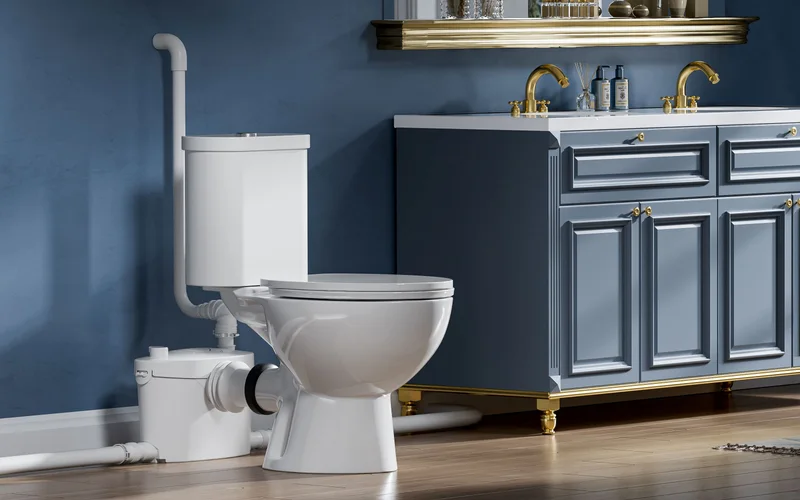
Getting your upflush toilet rough-in plumbing specifications right before framing walls prevents the two biggest headaches in basement remodels: failed inspections and noisy, sluggish drainage. Always cross-check these general US guidelines against your specific pump manual and local building department.
Core Rough-In Checklist (SNFLEX Verified Specs Reference)
| Rough-In Item | Typical US Requirement / SNFLEX Spec |
|---|---|
| Water Supply | 1/2” cold water line with angle shutoff valve (plus hot water if adding a vanity/shower) |
| Electrical | 110–120V / 60Hz GFCI-protected receptacle within cord reach |
| Discharge Pipe Size | 3/4” to 1” rigid Schedule 40 PVC or copper (SNFLEX 600W/750W outlets support 7/8” to 1-3/4”) |
| Auxiliary Inlets | 1-1/2” PVC/ABS drains (left, right, top) with minimum 1/4” per foot downward slope |
| Vent Pipe | 1-1/2” or 2” atmospheric vent tied to home’s vent stack (check local code) |
| Rear-Outlet Clearance | 15” minimum centerline to side wall; 21” minimum clear floor in front of bowl (IRC standard) |
Macerator Pump Discharge Pipe Size: 3/4” vs. 1”
Choosing between 3/4-inch and 1-inch discharge pipe is a balance between flow velocity and friction:
- Too wide (e.g., 2-inch): Slurry loses velocity during vertical climbs and solids can settle back down onto the check valve.
- 3/4-inch rigid pipe: Keeps upward velocity high on short vertical lifts, which helps flush the line clean.
- 1-inch rigid pipe: Reduces friction loss on longer horizontal runs across basement joists while keeping strong velocity.
Check your exact model’s multi-size cut-to-fit check valve (for instance, the SNFLEX Two-Piece 600W lists recommended outlet pipe sizes starting at 7/8” and 1”) and follow the manual’s pipe-size chart.
How to Vent a Macerating Toilet Properly (vs. Carbon Filters)
A macerator tank is a sealed chamber. When 1.28 gallons of toilet water plus shower greywater rushes in, air inside the box must escape; when the impeller empties the box in 5–10 seconds, air must rush back in so it does not siphon your sink or shower P-traps dry.
- Best practice (Code-compliant in most US jurisdictions): Run a dedicated 1-1/2” or 2” two-way atmospheric vent from the pump’s vent port up into your home’s existing vent stack (at least 6 inches above the flood rim of the highest fixture on that branch).
- Carbon filter (“ventless”) option: SNFLEX models ship with an integrated activated carbon filter (annual replacement recommended on the One-Piece 600W) designed to neutralize odors where running a vent pipe is impractical. Check your local plumbing code first—many US inspectors do not accept carbon filters in place of an exterior vent for permitted habitable bathrooms.
- Avoid AAVs (Air Admittance Valves): One-way mechanical vents cannot relieve positive air pressure when the pump chamber fills.
Rear-Outlet Toilet Bowl & Behind-Wall Rough-In
Because a rear-outlet toilet bowl for an upflush system discharges straight out the back rather than through the floor, you have two rough-in layouts:
- Exposed behind-bowl mount: Simplest rough-in; pump sits directly behind the toilet on the finished floor.
- Concealed behind-wall mount: Uses the extension pipe (included with SNFLEX Two-Piece 500W, 600W, 750W, and 19” Tall models) to place the pump inside a framed 2×4 or 2×6 utility chase—always leave a removable access panel.
Main Sewer Stack Connection Rules
When tying the macerator’s 3/4-inch or 1-inch discharge line into your home’s 3-inch or 4-inch main waste stack:
- Enter from above: Always drop into the top or upper 45-degree quadrant of a horizontal main line using an approved wye or combination wye-and-eighth-bend fitting so waste from upper floors cannot backflow into the discharge line.
- Avoid sanitary tees on horizontal lines: Standard US plumbing codes prohibit using a sanitary tee on its back for drainage connections.
- Add a full-port ball valve: Place a shutoff ball valve on the vertical discharge riser right above the check valve so you can isolate the pipe cleanly during maintenance.
Check SNFLEX Two-Piece 600W rough-in dimensions at Simple Project →
Next: see How to Connect a Shower & Sink to an Upflush Toilet or test your pipe layout in our Lift & Distance Checker.
Ready to check current specs & availability?
SNFLEX Two-Piece Macerating Toilet (600W)
600W macerating pump · up to 29 ft vertical / 295 ft horizontal · from $659 (checked 2026-11-23).
Frequently Asked Questions
Can I use an Air Admittance Valve (AAV / Studor vent) on a macerating toilet?
Generally no. AAVs only let air in (one-way), whereas a macerating pump chamber needs to push air out as water rushes in and draw air back in as it pumps empty. Use a true two-way atmospheric vent to your home's vent stack per local code.
Should I use 3/4-inch or 1-inch discharge pipe for a macerator pump?
Both 3/4-inch and 1-inch rigid PVC or copper are commonly supported (SNFLEX check-valve outlets accommodate 7/8", 1", 1-1/8", 1-1/4", and 1-1/2"+ sizes). Many plumbers prefer 1-inch rigid PVC on longer runs to reduce friction while maintaining enough velocity to keep slurry moving—always match your pump manual.
Are ventless carbon-filter upflush toilets legal everywhere in the US?
No. While built-in activated carbon filters help control odors in spaces where running a vent pipe is difficult, many US municipalities under IPC or UPC plumbing codes still require a dedicated atmospheric vent pipe for any sanitary macerator.
What is the rough-in clearance for a rear-outlet upflush toilet?
Unlike standard 12-inch floor-flange toilets, a rear-outlet bowl sits against the pump or extension pipe. For example, SNFLEX Two-Piece 600W lists minimum space required as 26-2/5" D × 30-7/10" H × 14-3/5" W (plus side and front code clearances).
Next Step
Check your vertical lift & horizontal pipe run
Test your exact vertical climb, horizontal run, and elbow count against SNFLEX pump specs.
Related Guides
How to Install an Upflush Toilet in a Basement (Guide)
Step-by-step US upflush toilet installation guide: tools needed, pipe layout, venting, common mistakes, and when to hire a licensed plumber.
GuidesConnect a Shower, Tub & Sink to an Upflush Toilet
How to connect a basement shower pan, bathtub, and vanity sink to a 4-inlet upflush macerating toilet pump—plus raised-base height rules.
CompareBest Upflush Toilet for a Basement (2026 Spec Guide)
Compare the best upflush and macerating toilets for basements: 500W, 600W, 750W, one-piece, and 19-inch tall kits verified by live specs.
GuidesMacerating Toilet: How It Works, Pros, Cons & Buying Guide
Everything US homeowners need to know about a macerating (upflush) toilet: how it works, lift limits, venting, noise, and how to pick the right model.
GuidesBasement Toilet Without Drain: No-Concrete-Cutting Guide
How to install a basement toilet without a floor drain or breaking concrete. Compare upflush toilets, sewage ejectors, and sub-slab options.