Macerating Toilet: How It Works, Pros, Cons & Buying Guide
Affiliate disclosure: We may earn a commission if you buy through links on this page, at no extra cost to you. We are an independent guide, not Simple Project. Read full disclosure.
Quick Answer
A macerating toilet (also called an upflush toilet system) pairs a rear-discharge ceramic bowl with an electric grinding pump that turns waste into a slurry and pumps it upward through a 3/4-inch to 1-inch pipe to your existing sewer stack—no concrete breaking required. Complete kits start around $639–$759.
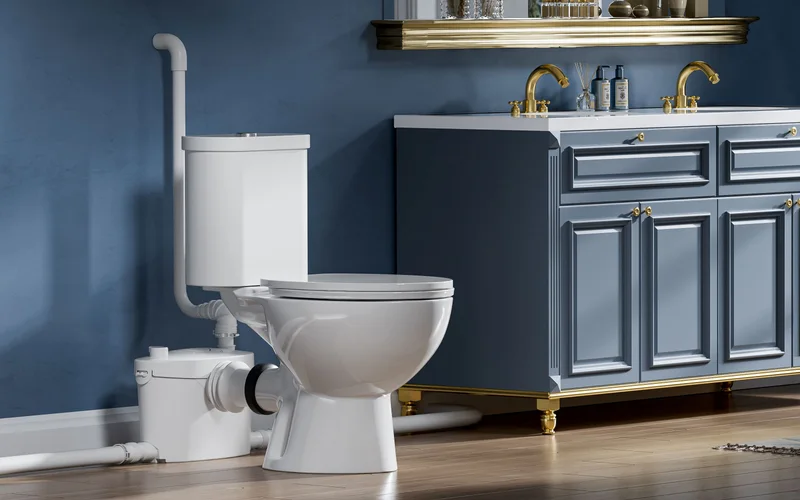
1. Traditional Gravity Drain (Breaks Slab)
2. Above-Floor Upflush System (No Concrete Cutting)
A macerating toilet—widely searched as an upflush toilet or upflush toilet system—solves one of the most frustrating problems in home remodeling: how to put a flushing bathroom in a basement, garage, shed, or attic where there is no gravity floor drain.
How a Macerating Toilet Works (Step by Step)
Unlike a conventional gravity toilet that drops waste straight down through a floor flange, a macerating toilet uses a rear-outlet ceramic bowl connected directly to a compact electric macerator pump:
- Flush: Pressing the flush button releases 0.8 or 1.28 gallons of water, carrying waste horizontally out the back of the bowl into the macerator tank.
- Float activation: Rising water inside the sealed box lifts an internal float switch, automatically starting the motor.
- Maceration: High-speed stainless-steel blades liquefy solid waste and toilet paper into a fine slurry in seconds.
- Upflush discharge: The impeller pumps the slurry upward through a narrow 3/4-inch to 1-inch discharge pipe—past a one-way check valve—into your home’s existing 3-inch or 4-inch sewer stack.
- Auto shutoff: Once the water level drops, the float switch shuts the pump off automatically. The entire cycle usually lasts 5 to 15 seconds.
Two Main Styles of Upflush Toilet Systems
- Two-Piece Rear-Discharge + External/Behind-Wall Pump: The pump sits directly behind the toilet or hidden inside an adjacent framed wall using an extension pipe (included with SNFLEX 500W, 600W, 750W, and 19” Tall models). Best for easy service access and clean aesthetics.
- One-Piece / Compact System: The pump is tucked cleanly behind a sleek one-piece ceramic skirt (such as the SNFLEX One-Piece 600W) or built directly into the bowl (such as the Saniflo Sanicompact). Best for tight spaces where building a false wall is impossible.
What Else Can Connect to an Upflush System?
Most modern basement macerating pumps include three auxiliary 1-1/2-inch inlets (left, right, and top) in addition to the main toilet inlet. That allows one pump to drain:
- A bathroom vanity sink
- A raised basement shower pan
- A bathtub (raised to maintain gravity slope)
- Even a washing machine on models rated for higher water temperatures (check your exact manual; e.g., SNFLEX One-Piece 600W lists max water temp 65°C / 80°C for 1 hour)
See exact hookup rules in How to Connect a Shower & Sink to an Upflush Toilet.
Buying Checklist: 4 Specs That Matter Most
- Vertical Lift & Horizontal Run: Match the motor to your actual pipe path (SNFLEX 500W = 23 ft V / 230 ft H; 600W = 29 ft V / 295 ft H; 750W = 36 ft V / 360 ft H). Verify with our Lift & Distance Checker.
- Noise Rating & Mounting: Look for quiet-rated pumps (35–45 dBA manufacturer spec on SNFLEX two-piece models) and strap discharge pipes firmly to joists to prevent rattle.
- Venting Compliance: Carbon filters help control odor, but local US plumbing codes frequently require an atmospheric vent pipe. Read Upflush Toilet Rough-In & Venting.
- Warranty & Replacement Parts: Check both ceramic and pump warranty terms and confirm standalone replacement pumps are available.
Explore SNFLEX 500W, 600W & 750W Macerating Toilets at Simple Project →
Detailed Pros and Cons of Macerating Toilets
Where a Macerating Toilet Shines
- Preserves the slab: Ideal for finished basements, post-tensioned concrete slabs, radiant-heated floors, or older stone foundations where cutting trenches risks waterproofing or structural issues.
- Lower total project cost: Avoiding slab saw-cutting, gravel excavation, and concrete repouring routinely saves $1,500–$4,000+ compared to sub-slab rough-ins.
- Multi-fixture consolidation: One 4-inlet pump can serve a toilet, vanity sink, and raised shower pan simultaneously, eliminating separate greywater lift pumps.
- Fast turnaround: Setting the bowl, pump, and discharge line takes a fraction of the time of multi-day trenching.
Realistic Limitations to Plan Around
- Electricity dependency: Without 110–120V power, the pump cannot discharge. Do not flush during power outages.
- Brief operating noise: Expect a 5- to 15-second motor hum per flush (SNFLEX lists 35–45 dBA on its 500W/600W/750W two-piece units). Placing the pump behind a framed stud wall and strapping discharge pipes tightly to joists keeps noise minimal.
- Raised shower base needed: Because water must flow downward into the pump’s side inlet, a basement shower connected to a macerator requires a 6- to 8-inch raised platform.
- Care with non-biodegradables: Never flush wipes, paper towels, feminine hygiene products, cotton swabs, or dental floss.
Upflush Toilet System Maintenance & Lifespan Tips
A residential macerating pump is a simple electro-mechanical appliance—an electric motor, stainless-steel cutting blade/impeller, float switch, and check valve. To maximize service life:
- Install a service ball valve: Put a full-port ball valve on the vertical discharge line above the pump so you can shut off the water column cleanly if you ever open the top access panel.
- Use 45-degree sweeps instead of sharp 90s: Fewer sharp turns mean lower backpressure and shorter pump run cycles.
- Replace the carbon filter annually (if used): If local code permits ventless operation with an activated carbon filter, swap the filter cartridge once a year to keep odors neutralized.
- Keep water temperatures within spec: If tying in a washing machine or hot-water fixture, check the pump’s max temperature rating (for instance, SNFLEX One-Piece 600W lists 65°C continuous / 80°C for 1 hour).
Next Steps Before Buying
- Confirm whether an upflush system, sewage ejector, or gravity drain fits your slab with our 60-Second Upflush Quiz.
- Measure your vertical climb and horizontal distance in the Lift & Distance Checker.
- Compare verified models and pricing in Best Upflush Toilet for a Basement or read our Saniflo vs. Simple Project comparison.
Always follow your pump’s installation manual and local US plumbing codes; consult a licensed plumber when tying into your home’s main drain and vent stacks.
Ready to check current specs & availability?
SNFLEX Two-Piece Macerating Toilet (600W)
600W macerating pump · up to 29 ft vertical / 295 ft horizontal · from $659 (checked 2026-11-23).
Frequently Asked Questions
What is the difference between a macerating toilet and an upflush toilet?
In residential US plumbing, the terms are used interchangeably. 'Macerating' describes the stainless-steel blade mechanism that grinds waste into a slurry, while 'upflush' describes its ability to pump wastewater upward to an overhead sewer line.
Do macerating toilets smell?
No—when properly installed and sealed, a macerating toilet does not smell. Units use airtight gaskets, check valves, and either an activated carbon filter or a code-approved atmospheric vent pipe to keep sewer gases out of the room.
How long do macerating toilet pumps last?
Lifespan depends on usage, water hardness, and avoiding forbidden items (like wipes). With normal residential care and periodic descaling, quality macerator pumps commonly run for many years, and standalone replacement pumps ($269.99–$309.99 for SNFLEX) can be swapped without replacing the ceramic toilet.
Can you put toilet paper in a macerating toilet?
Yes. Standard human waste and normal toilet paper are exactly what macerating blades are designed to process. Never flush wet wipes (even 'flushable' ones), paper towels, cotton swabs, or hygiene products.
How much electricity does an upflush toilet use?
Very little. Even a 600W or 750W pump only runs for about 5 to 15 seconds per flush on a standard 110–120V GFCI circuit, adding pennies per month to a typical electric bill.
Next Step
Compare the top 5 basement upflush toilets
See verified lift ratings, inlets, and live-checked prices side by side.
Related Guides
Best Upflush Toilet for a Basement (2026 Spec Guide)
Compare the best upflush and macerating toilets for basements: 500W, 600W, 750W, one-piece, and 19-inch tall kits verified by live specs.
GuidesBasement Toilet Without Drain: No-Concrete-Cutting Guide
How to install a basement toilet without a floor drain or breaking concrete. Compare upflush toilets, sewage ejectors, and sub-slab options.
ReviewsSimple Project SNFLEX Macerating Toilet Review (2026)
Honest desk-researched review of Simple Project SNFLEX 500W, 600W, and 750W macerating toilets: verified specs, warranty, pros, and cons.
CompareSaniflo vs. Simple Project (SNFLEX) Macerating Toilet
Neutral, spec-verified comparison of Saniflo (Saniaccess 3, Sanicompact) vs. Simple Project SNFLEX: lift, wattage, warranty, and price.
GuidesHow to Install an Upflush Toilet in a Basement (Guide)
Step-by-step US upflush toilet installation guide: tools needed, pipe layout, venting, common mistakes, and when to hire a licensed plumber.