Basement Toilet Without Drain: No-Concrete-Cutting Guide
Affiliate disclosure: We may earn a commission if you buy through links on this page, at no extra cost to you. We are an independent guide, not Simple Project. Read full disclosure.
Quick Answer
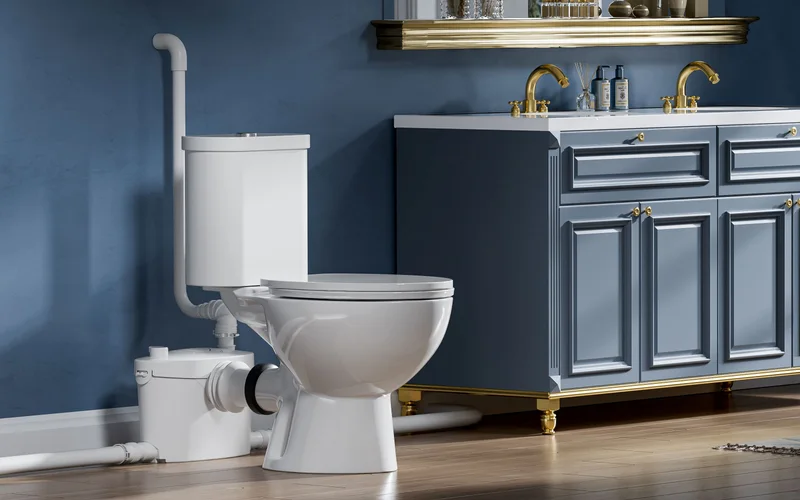
The easiest way to add a basement toilet without a drain—and without breaking concrete—is an above-floor upflush (macerating) toilet. It sits directly on your slab, grinds waste into a slurry, and pumps it upward through a 3/4-inch to 1-inch pipe to your overhead sewer line for $1,000–$3,500 installed.
1. Traditional Gravity Drain (Breaks Slab)
2. Above-Floor Upflush System (No Concrete Cutting)
If your basement has a bare concrete slab and your home’s main sewer pipe exits halfway up the foundation wall, a standard gravity toilet will not work. Installing a basement toilet without a drain used to mean renting a concrete saw, jackhammering a trench across the basement, hauling rubble, and paying a plumber $3,000 to $7,000+ to rough in underground PVC.
Today, an above-floor plumbing toilet system—commonly called an upflush or macerating toilet—lets you add a working toilet (and even a sink and shower) directly on top of an intact concrete slab.
Why Standard Toilets Fail Below the Sewer Line
Gravity plumbing relies on downward slope—typically 1/4 inch of drop per foot of horizontal pipe—all the way to the municipal sewer or septic tank. In many US homes, the main waste line exits the basement wall 3 to 5 feet above the concrete floor. Even when the main line sits under the slab, trenching through 4-inch reinforced concrete to reach it is loud, dusty, and expensive.
Your 3 Realistic Toilet Options for a Basement Slab Foundation
| Option | Concrete Breaking? | Typical US Installed Cost* | Best Fit |
|---|---|---|---|
| Upflush / Macerating Toilet | No | $1,000–$3,500 | Finished basements, half or full baths, tight budgets |
| Sewage Ejector Pit & Pump | Yes (24”×30” pit cutout) | $2,000–$5,500 | Heavy-use full basement bathrooms + laundry |
| Gravity Drain Trench | Yes (full floor trench) | $3,000–$7,000+ | Unfinished basements where main sewer sits deep under slab |
*Cost ranges reflect published US contractor cost guides (Angi/HomeAdvisor, 2025–2026) and vary by region. Run our Basement Toilet Cost Calculator for a tailored estimate.
How a No-Trench Toilet System Works
A no-trench toilet system for a basement pairs a rear-discharge ceramic toilet with an electric macerator box placed directly behind the bowl or concealed behind a partition wall:
- You flush the toilet normally (0.8 or 1.28 gallons per flush on WaterSense models).
- Water and waste enter the sealed macerator housing via the rear outlet.
- An internal float switch triggers stainless-steel macerating blades for roughly 5 to 15 seconds.
- The pump pushes the fine slurry upward through a small 3/4-inch to 1-inch rigid PVC or copper discharge line, through an external check valve, and into the top of your existing overhead sewer stack.
Because the discharge pipe is small and pressurized, it can run inside a standard stud wall or neatly along basement ceiling joists—zero concrete cutting required.
What You Still Need in the Basement
Even without a floor drain, an above-floor upflush toilet requires four connections:
- Cold water supply: A standard 1/2-inch cold water line tapped from nearby basement joists.
- GFCI electrical outlet: A 110–120V GFCI-protected receptacle within reach of the pump cord.
- Sewer stack tie-in: Access to your home’s existing 3-inch or 4-inch main waste stack using an approved wye fitting.
- Venting: While kits like SNFLEX include an activated carbon filter for odor control, local US plumbing codes often require a true atmospheric vent line tied into your home’s vent stack. Read our Rough-In & Venting Guide before framing walls.
Mid-Page Pick: Best All-Around Basement Upflush System
If you are ready to price out a complete kit, the SNFLEX Two-Piece 600W Macerating Toilet (from $659, checked 2026-11-23) is rated for up to 29 ft of vertical lift and 295 ft of horizontal discharge, includes a behind-wall extension pipe, and provides four inlets so you can tie in a vanity sink or raised shower pan.
Check current price on SNFLEX Two-Piece 600W at Simple Project →
When Should You Still Break Concrete Instead?
Be honest about the trade-offs before skipping trenching:
- Choose a sewage ejector pit if you are building a high-traffic basement apartment with a washing machine, full tub, and multiple occupants where a submerged 2-inch solids-handling pump is preferred.
- Choose a gravity trench if your basement is completely unfinished, your main sewer exits below the slab, and you want zero mechanical pumps to maintain long-term.
- Choose an upflush toilet if your basement is already finished, your sewer line is above the floor, or you want to save $2,000–$4,000+ on demolition and concrete work.
Compare all three side by side in Gravity Drain vs. Macerator Pump Bathroom, or take our 60-Second Upflush Quiz.
Code & Installation Reminder
Always follow your pump manufacturer’s installation manual and check local US plumbing codes and permit rules before tapping into a main waste stack. If you are not comfortable cutting into cast-iron or ABS/PVC main drain stacks, hire a licensed plumber for the stack tie-in and vent connection.
Planning Your Above-Floor Layout: Clearances, Water & Power
Even when you avoid concrete trenching, an above floor plumbing toilet system still has to respect standard US building clearances and utility connections so the bathroom feels comfortable and passes inspection:
- Toilet clearances (IRC standard): Leave at least 15 inches from the center of the toilet bowl to any side wall, vanity cabinet, or shower enclosure, and at least 21 inches of clear floor space in front of the bowl (24 inches feels noticeably better in daily use).
- Behind-the-wall vs. exposed pump: Two-piece systems such as the SNFLEX 500W, 600W, and 750W kits include an extension pipe so you can frame a shallow 2×4 or 2×6 false wall and hide the macerator box inside the utility chase. Always frame a removable access door—never drywall permanently over a mechanical pump.
- Cold water supply: Bring a 1/2-inch PEX or copper cold water line to a standard quarter-turn angle stop on the left side of the toilet.
- Dedicated or GFCI-protected receptacle: Macerator pumps plug into a standard 110–120V/60Hz GFCI outlet. Never run an extension cord through drywall or over a wet slab.
- Discharge routing: Run the 3/4-inch or 1-inch discharge pipe vertically first to ceiling height, then slope the horizontal run slightly downward (about 1/4 inch per foot) toward the main waste stack so slurry never sits stagnant in horizontal pipe.
How to Pick the Right Pump Wattage for Your Basement
Not every basement needs the biggest motor, and buying too little lift can cause sluggish draining on long runs:
- 500W (e.g., SNFLEX Two-Piece 500W, from $639): Rated up to 23 ft vertical / 230 ft horizontal. Fine for a simple basement half bath directly beneath the main sewer stack with minimal turns.
- 600W (e.g., SNFLEX Two-Piece 600W, from $659): Rated up to 29 ft vertical / 295 ft horizontal. Costs only $20 more than 500W and gives safer headroom for 8–9 ft ceilings plus a sink or shower.
- 750W (e.g., SNFLEX Two-Piece 750W, from $724): Rated up to 36 ft vertical / 360 ft horizontal. Best for deep basements, detached garages, or runs across multiple joists with several 45-degree or 90-degree turns.
Sub-Ground Toilet Plumbing Systems: Real-World Maintenance Habits
Homeowners switching from gravity toilets to a sub ground toilet plumbing system with a macerator only need two simple habits to keep the pump trouble-free:
- Strict “flushables” rule: Only human waste and normal toilet paper belong in the bowl. Even wipes labeled “flushable” do not disintegrate fast enough and can bind around stainless-steel macerator blades.
- Periodic descaling in hard-water areas: Every 3 to 6 months, unplug the pump and run a manufacturer-approved descaler (never harsh drain-cleaning acids or bleach bombs that degrade rubber seals) to keep mineral scale off the float switch and impeller.
If you are ready to compare models, head to our Best Upflush Toilet for a Basement roundup or estimate your project budget in the Upflush Toilet Cost Guide.
Ready to check current specs & availability?
SNFLEX Two-Piece Macerating Toilet (600W)
600W macerating pump · up to 29 ft vertical / 295 ft horizontal · from $659 (checked 2026-11-23).
Frequently Asked Questions
What is the easiest way to add a toilet in a basement without a drain?
An above-floor macerating (upflush) toilet is the least invasive option. Because it requires no slab saw-cutting or trenching, it can often be installed in a single day once water, GFCI power, and a stack tie-in are ready.
Can you install a toilet below the main sewer line?
Yes, but not with a standard gravity toilet alone. Whenever a basement floor sits below the home's main sewer exit, you need a mechanical pump—either an above-floor macerating toilet or a buried sewage ejector pit.
Are there plumbing alternatives to jackhammering a basement floor?
Yes. Above-floor macerating systems (such as SNFLEX or Saniflo) pump waste up to existing overhead drain lines without touching the slab. Composting or incinerating toilets also avoid concrete cutting, though they are rarely used in primary urban/suburban basements.
Do I still need a permit for a no-trench basement toilet?
In most US jurisdictions, yes. Even when you do not break concrete, tying a new sanitary fixture into your home's main waste stack and venting system typically requires a plumbing permit and inspection.
What happens if the power goes out with a basement upflush toilet?
Because the macerator pump runs on 110–120V electricity, you should not flush the toilet during a power outage. Most homes still have gravity toilets on upper floors that continue working normally.
Next Step
Compare the best basement upflush toilets
See verified lift ratings, inlets, and current prices across 500W, 600W, and 750W kits.
Related Guides
Best Upflush Toilet for a Basement (2026 Spec Guide)
Compare the best upflush and macerating toilets for basements: 500W, 600W, 750W, one-piece, and 19-inch tall kits verified by live specs.
GuidesMacerating Toilet: How It Works, Pros, Cons & Buying Guide
Everything US homeowners need to know about a macerating (upflush) toilet: how it works, lift limits, venting, noise, and how to pick the right model.
CompareGravity Drain vs. Macerator Pump Bathroom (Pros & Cons)
Compare a gravity drain, sewage ejector pit, and upflush macerator pump for a basement bathroom: costs, noise, concrete work, and longevity.
GuidesUpflush Toilet for Basement Cost (2026 US Breakdown)
Real US cost breakdown to install an upflush macerating toilet in a basement vs. sewage ejector pit and concrete trenching.
Basement BathroomAdding a Bathroom to a Basement With an Upflush Toilet
Complete US project guide for adding a half or full basement bathroom using an upflush macerating toilet: layout, fixtures, venting, and order of work.